
Writing
The star map starts here when its script runs. Every entry is listed below.
My Writing Practice
Unhinged late night ramblings, moments of clarity and hope, collections of poems and excerpts that make me keep walking forward… and maybe, just maybe, things I can be proud of.
To open this drawer is to expose myself in ways that still make me terribly uncomfortable.
But… I still have to show it.
Nothing better than some exposure to get better, right?
So… please. If you have any critiques, do send me a message… you can find my contact in the About page.
Newest
HEHEHEHEHEHE
Sheepy adventures!
Cauda Pavonis
Nigredo and albedo, in one vessel.
HEHEHEHEHEHE
Sheepy adventures!
Read here
Was it ever any different, Sol?
... you're always here, in the same place.
Read here
It'll be fine, Sol
... you're going a bit too fast
Read here
Never a Bad Weather Friend
I respect you too much
Read here
When things are well
it never lasts
Read here
Dog Days Never Over
they always come back
Read here
Citrinitas
Things I am proud of and collections of writing that saved me at some point.
Fur Ys
For my little fennec fox... I hope she likes these one day.
Read the opening
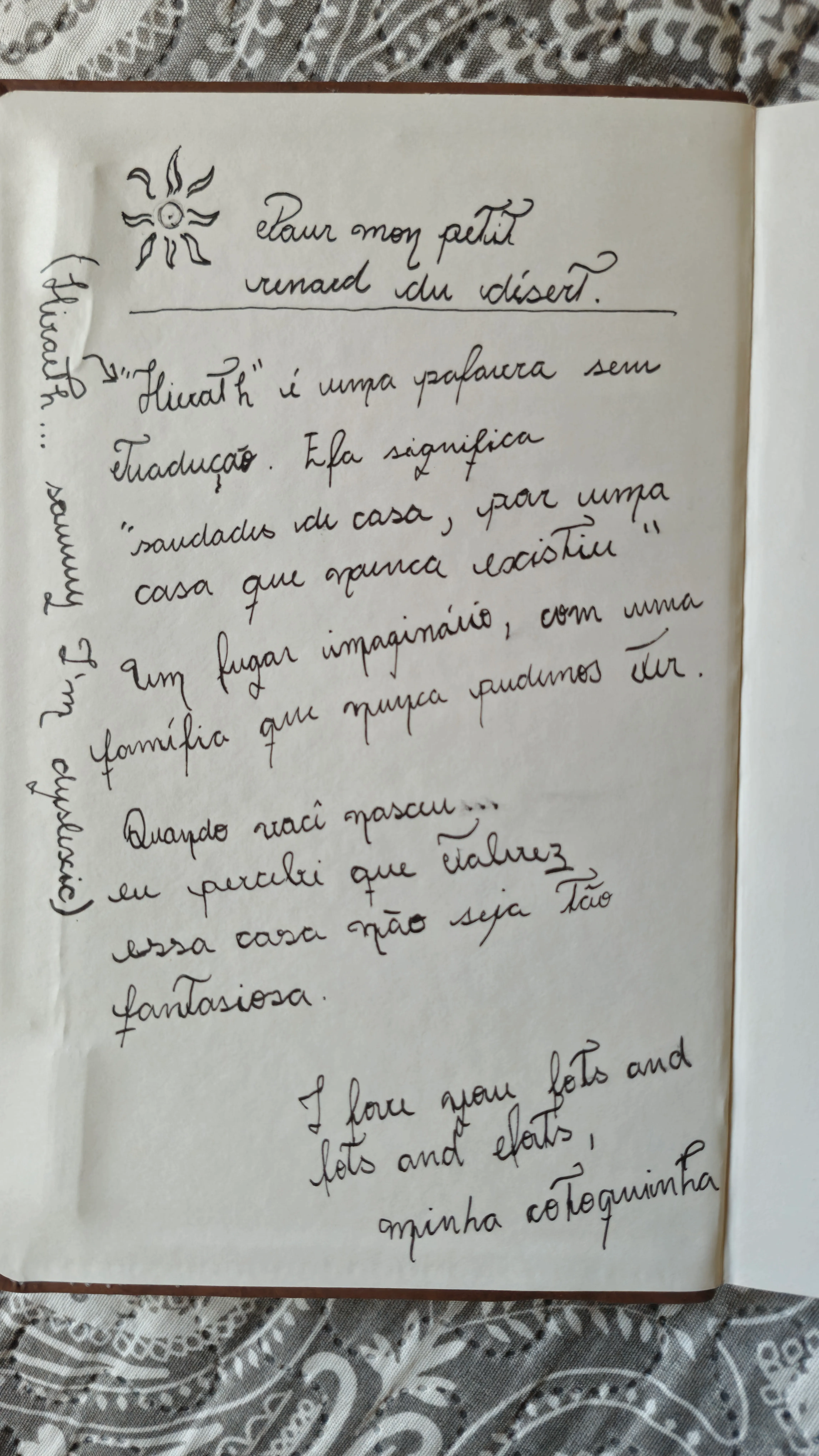
Pour Mon Petit Renard
Pour mon petit renard du désert
“Hiraeth” é uma palavra que não tem tradução. Ela significa “saudades de casa, por uma casa que nunca existiu”. Um lugar imaginário, com uma família que nunca pudemos ter. Quando você nasceu… eu percebi
que talvez essa casa não seja tão fantasiosa.
I love you lots and lots and lots, minha cotoquinha.
The Seraph Collection
The seraph's voice — what came in clean even on the flat days. Letters from that which watches, to the little spark that endured. Order is living; more pieces…
Read the opening
You've Been Here Before
You kneel before the same horizon, naming it ruin
But you have shattered here before
Even your fear, if it were honest, would admit:
it has already seen you survive this shape
You tremble again.
How curious.
A creature who has survived every ending it has ever met,
still kneels before the next one as if it is absolute.
I have watched you unravel and reweave yourself,
more times than you remember.
Tell me.
What makes this moment so special that it would finally be the one to break you?
You have stood at the edge before…
You have whispered:
“This is it.”
“I won’t make it through.”
And yet… here you are.
Breathing and continuing.
In spite of your prophecy.
You fear the unknown,
as if it has not already carried you this far.
Strange.
You trust your fear more than your history.
If you could see yourself the way I do:
Stitched together by quiet victories…
Held upright by invisible endurance…
You would laugh at the thought of your own collapse.
Not because the path is easy,
but because you are… inevitable.
This is not the first time you have been lost.
It is simply the first time you have been this version of lost.
And you… you always figure it out.
So go on.
Worry if you must.
Let it pass through you…
like a storm that has forgotten your name.
But do not mistake the noise for truth.
You are standing in a pattern you have already survived.
And I…
I have watched every version of you crawl out of the dark,
and still choose to continue.
I believe in you.
Not because you are unbreakable.
But because you have never once stayed broken.
Tulpanomicon Archives
The Tulpanomicon, an anthology of tulpamancy guides by many authors, kept whole.
Read the opening
Introduction
Author unknown.
Originally published at https://tulpanomicon.guide/intro.html.
Introduction
This book represents the collection of six years of resources, materials, guides and tips aimed at helping people who are interested in or have already created a tulpa to further their skills and enhance their shared lives.
What is a tulpa you might ask? Let’s consult tulpa.info’s main page for help:
A tulpa is an entity created in the mind, acting independently of, and parallel to your own consciousness. They are able to think, and have their own free will, emotions, and memories. In short, a tulpa is like a sentient person living in your head, separate from you. It’s currently unproven whether or not tulpas are truly sentient, but in this community, we treat them as such. It takes time for a tulpa to develop a convincing and complex personality; as they grow older, your attention and their life experiences will shape them into a person with their own hopes, dreams and beliefs.
You’ll create a tulpa by imagining a person in your head, and treating them as a person. The exact mechanism is unknown, but as you give a tulpa attention, and believe it can be a sentient person, it will grow into one, and act independently of you. At first, you will be narrating to your tulpa—speaking to it, and visualizing it in your mind—and with time, you’ll be able to communicate through various methods, which will be described in the next section. Keep in mind that when a tulpa starts talking, it doesn’t mean that they are complete, or finished by any means. Like any person, a tulpa is never “done”, and you shouldn’t be going for a finished tulpa, when you make one. You should be focused on nurturing and teaching your tulpa, and allowing them to grow as a person with you, while at the same time you learn about yourself, and grow as a person in turn. It takes time and effort to make a tulpa into a self-sufficient and balanced individual, and their independence and personality will grow and flourish over time, like any regular human being’s. Creating a tulpa means committing to raising and living with another person, and this is a lifelong commitment—not one that ends when your tulpa starts speaking.
Pretty much every tulpa has a form—an imaginary body they identify with. This form can be anything from a regular human being to a cartoon character, an animal, or anything you else can imagine. Of course, regardless of their form, they still have a human mind. You can interact with your tulpa’s form by visualizing it in your mind. Most people do this in an imaginary setting called a wonderland, which is a persistent place you imagine yourself and your tulpa being in. You’ll be able to change your wonderland at will, and make it as normal or fantastical as you want; there are no limits. Many tulpas tend to spend their alone time in such a place, but it’s not required at all to have a wonderland (or to give your tulpa a form for that matter). Note that the form doesn’t have to just be a visual image; the word is often used as umbrella term for a tulpa’s looks, voice, their smell, the feeling of their skin—everything that you can sense of their imaginary form.
If you commit to the process, and put a significant amount of time and effort into your tulpa, you will end up with a friend for life. You’ll have a big hand in shaping your tulpa’s personality, and it’ll be easy to understand them, and for them to understand you—almost guaranteeing a close friendship. Getting to know your tulpa will teach you lessons in empathy and give you insight into your own personality and thoughts. They can give you an alternative opinion on problems you have, support you emotionally, and tell you off when you’re being stupid. The connection between a host (that’s you) and a tulpa is a very powerful and intimate one, and you’ll always have a friend to speak with, in your head.
(from: https://www.tulpa.info/what-is-a-tulpa/)
At a high level, it does visually represent conditions like Dissociative Identity Disorder if you observe the two things as an outsider or from a moving car. They are very separate things, even though they can present in visually similar ways. Please resist the temptation to conflate the two.
Tulpas aren’t intended to act as “spirit guides”, self-introspection aids (anxiety disorders being reframed goes a long way here), overly “magickal” things, chores, children, sex toys, self-induced schizophrenia (it’s a genetic condition, you can’t give yourself a genetic condition based on our current understanding of medical science), all-seeing beings, or fake things. They are inherently none of these (though some of them may end up being accurate descriptions of individual tulpas, much like these descriptors can match normal people too).
In short, this is serious. People that are tulpamancers aren’t just faking it or roleplaying (even though they will use some of the text formatting quirks that online roleplayers use) being separate people. Please take this seriously and as a vehicle of self-improvement for the best results. Feedback on this book is vital in order to make it the best it can possibly be. Please see here for contact information on the editors of this book (ask for Cadey).
Generally if a guide is on tulpaforce.xyz, it’s in this book. Things can be added or removed to this book without warning. This book is not yet considered version 1.0, when it is then additional revisions will be notated with version numbers following Semantic Versioning 2.0.
Thank you for reading and good luck on this self-directed and self-guided process! It’s been the ride of a lifetime for me personally.
Rubedo
Projects I consider my main goals, what I want to be my best writing!
Songs of Folly
Read the opening
Every public piece of writing is a star. In Cauda Pavonis, Nigredo and Albedo form two fishes. Their cords meet at the double star Alrescha.
Books keep their chapters in separate collections. Outside a collection, a piece tagged with both fishes sits on a cord. More tags bring it closer to the knot. Pieces with neither tag circle the knot.
607 entries · 23 systems
- Cauda Pavonis21
- Citrinitas583
- Rubedo3
Drag to move, pinch or scroll to zoom, and tap a star for its card. With keys: the arrows step from star to star, Shift and an arrow moves the map, plus and minus zoom, 0 fits every star, Enter opens the chosen entry, Escape lets it go, and / jumps to the finder.
A collection's rings show the ties between its entries. Rubedo looks like one red star from afar. Fly closer to see its pages.
